The Journey of Enlightenment

The Journey of Enlightenment

Plato’s Allegory of the Cave and the film “Pleasantville” share many similarities as they provide insight into enlightenment, knowledge, and individual perception of reality. The Allegory of the Cave comes from Plato’s book of philosophical fiction, The Republic. Photo moon in sky at night background asset game 2d futuristic generative aiPlato was a Greek philosopher who wrote most of his work in dialogues between his old teacher, Socrates and some of Socrates’ followers and critics. In the Republic, Socrates shares a story of people living in a cave with his follower Glaucon. The story is an allegory for human society and the pursuit of knowledge. The story describes chained prisoners who were placed in a cave from birth. The prisoners were chained in a way where they were only able to face the wall in front of them without being able to move their heads and limbs. A fire was placed on the opposite side of the cave with a raised walkway. Puppeteers would carry many objects and statues along the raised pathway, casting shadows on the wall the prisoners could see. As the prisoners only saw the shadows of the objects, the shapes were changed and appeared bizarre to the prisoners. The shadows were used to describe the prisoners’ reality, as they viewed the world through shadows or given information. A prisoner was then released from the cave and was dragged outside. At first, the freed prisoner was blinded by the light but soon became accustomed to his surroundings. As he was able to get used to the light, he began to perceive the actual reality of the world and was able to acknowledge the shadows as only being illusions. The realization and recognition experienced by the freed prisoner symbolize expanding knowledge and recognizing the truth. The freed prisoner tries to tell his fellow prisoners in the cave about the outside world, but they are reluctant and believe he is crazy, unable to accept reality. The reluctant prisoners represent those unwilling to obtain new knowledge and truth as they consider their reality the world’s true reality. The film “Pleasantville” is a story of two teens, David and Jennifer, from the 1990s who were transported into a back-and-white television sitcom set in the 1950s called “Pleasantville.” The presence of the two teens disrupts the “perfect” world of Pleasantville as they challenge the town’s conservative values and beliefs, which leads to black-and-white objects and people being seen in color. The citizens of Pleasantville experience new knowledge and ideas, which lead them to undergo personal changes that question their previous traditional lives. The story shares the power of embracing change to explore one’s true nature in a “perfect” yet unresourceful world.

The Allegory of the Cave and “Pleasantville” explore parallel themes of enlightenment and knowledge. The metaphor of illusion and reality is evident in both stories. In Pleasantville, citizens live in a black-and-white world that lacks the knowledge and ideas of David and Jennifer, both citizens of the outside world. a red rose with water droplets on it's petals in the dark, surrounded by leavesIn the Allegory of the Cave, Plato shows the difference by contrasting the people living outside the cave and the prisoners who were forced to look at the shadows cast by objects. The two mediums explore the journey of enlightenment from ignorance. The people in “Pleasantville” all undergo a transformation from realization and self-discovery when they question the reality of the world they are living in to find the truths of life. When the individuals in Bill Johnson’s soda shop ask Bud about the books’ storyline and David’s original home, they try to understand the truth that lies beyond their everyday lives. The Allegory of the Cave and “Pleasantville” both explore the concept of breaking social norms. In the Allegory of the Cave, the freed prisoner challenges the prisoners’ daily lives by expressing his finding of the outside world. The prisoners cannot accept the true reality of their world and believe the freed prisoner has lost his mind. The freed prisoner feels pity for the reluctant prisoners but continues to live truthfully. In “Pleasantville,” the citizens who appear in color challenge the beliefs of the citizens seen in black-and-white. The citizens of color accept knowledge and the truth, encouraging a shift in the understanding of reality within the population.Glowing light bulb and book or text book with futuristic icon. Self learning or education knowledge and business studying concept. Idea of learning online class or e-learning at home. David was able to help his dad in “Pleasantville,” George, be seen in color when he could give words to the emotions he felt towards his wife, Betty. Lastly, in both texts, the symbolism of the light is evident. The light is used to express knowledge, truth, and enlightenment. The characters could move away from the darkness and into the light when they accepted the realities presented to them. The light or color demonstrates the perception of the true world in a new way. Plato’s Allegory of the Cave and “Pleasantville” show the importance of critical thinking, self-discovery, and the striving for knowledge.

——————————————————————————————————————————————————-

References:

https://www.freepik.com/free-photos-vectors/enlightenment-art/16 

https://www.islamicity.org/19464/bringing-light-to-the-darkness/ 

https://citinewsroom.com/2023/08/unveiling-your-9-senses-the-path-to-self-discovery-and-personal-transformation-article/ 

https://stock.adobe.com/search?k=knowledge 

https://www.pinterest.ca/pin/626774473115445573/

Epiphany


What are your thoughts about the idea of ‘epiphany’ in relation to the story “Cathedral?”

It’s no secret that life passes us by everyday. Often times we are stuck in a constant loop living the same day repeatedly over and over again. It’s inevitable when life is more of a task than it is enjoyable. That being until we experience something new. Something that changes our perspective on life. Something so far out of our comfort zones that if we are lucky, will result in an epiphany. The word epiphany can be defined as a moment in which you suddenly see or understand something in a new or very clear way. Raymond Carvers “Cathedral” provides a deeper insight to this idea of “epiphany” and what truly happens to someone when they experience one.

“And his being blind bothered me. My idea of blindness came from the movies. In the movies, the blind moved slowly and never laughed. Sometimes they were led by seeing-eye dogs. A blind man in my house was not something I looked forward too”  

This quote said by the narrator demonstrates a close-minded individual and an unwillingness to try something new. Before his epiphany, the narrator is initially out of touch with himself. He sees the world through a screen and fails to understands how it operates outside in reality. His personality radiates through this quote. Although the narrator in the story is not literally blind, he portrays a lack of insight and awareness which you can argue makes him even more blind than Robert. For example he pities Beulah because Robert could never look at her. However what he fails to realize is that Robert was able to connect with his wife in a non-physical way and understand her on an intimate level. This is something the narrator does not have with his wife at all, as he evidently makes no effort to get to know her any further. This is shown through his bitter jealous feelings towards Robert as the narrator immediately categorizes Robert as apart of his wife’s past.

The moment leading up to the epiphany that the narrator has happens when the blind man in the story persuades the narrator to close his eyes and visualize drawing a cathedral. With the blind mans hand over the narrators whilst drawing, the narrator experiences an epiphany where he could see more then and there with his eyes closed than he ever could with his eyes open.

“So we kept on with it. His fingers rode my fingers as my hands went over the paper. It was like nothing else in my life up to now. Then he said ‘I think that’s it. I think you got it,’ he said. ‘Take a look. What do you think?’ But I had my eyes closed. I thought I’d keep them that way for a little longer. I thought it was something I ought to do. ‘Well?’ he said. ‘Are you looking?’ My eyes were still closed. I was in my house. I knew that. But I didn’t feel like I was inside anything. ‘Its really something, ‘I said.”

The closing passage of the story details the epiphany that strikes the narrator at the end. It reveals a shift towards freedom from the narrators self confinement in his own life. In the quote it’s revealed that he reconsiders the meaning of sight since he leaves his eyes shut yet confesses to seeing something. The narrator finally realizes that he’s been trapping himself within the walls of his house and life, ignoring the greater freedom that’s always been available to him which its not having to be inside of anything. Through no longer looking at the life that surrounds him, he allows himself to open up and see a “greater world”. He can now see things beyond the surface in which they lay in.


Elite gymnastics was among the many constants in my life growing up that led me to new experiences, some that were out of my comfort zone much like the narrators “blind drawing” of the cathedral in the short story. One particular instance that happened on a no more than ordinary day of training resulted in me having an epiphany, thus opening my eyes and changing my perspective on how I saw things. I was working very hard on bars trying to achieve a skill known as a Shaposhnikova. The move consists of me flinging my body backwards from the low bar after rotating underneath, and turning half way during the transition from low too high bar. The aim of the move is to catch the bar facing forwards. It’s deemed a very difficult skill to achieve and master, and I underestimated its difficulty. The frustration was visible after many failed attempts, so my coach sat me down and told me to close my eyes, just like how the blind man told the narrator to close his eyes in the story. My coach then walked me through the move visually, and I went on a journey inside of my head on what the skill felt and looked like. Then, my coaches next course of actions was having me actually attempt the skill but with my eyes shut. He instructed me to go back on that journey of me doing the skill inside of my head however doing it for real this time on bars with his spot. The results were that I was successful in performing the skill. That ordinary gym practice had turned into a day where I experienced an epiphany. From that day forward, I saw gymnastics through a different perspective. I understood what it meant to go through the motions of a skill both physically as well as inside of my head. The way I trained changed, and my methods of achieving skills changed as well. So often we are caught up in the walls we confine ourselves too that we fail to see the bigger picture. Experiencing an epiphany was door opening and allowed me to think and see “outside of the box”. It was only then that my success and achievements meant something. Through an epiphany I was met with self growth and an eye-opening experience that changed my course of life.


Plato and the Process of Discovering Me

Plato and the Process of Discovering Me

I don’t know how to start this. 

How much will I be able to write? (That, my friend, is a good question, I reply to that inner voice.)

Still, I have to think of something

…ah! What about the age-old question that is my identity? I can write about self-enlightenment!

In terms of “shallow” enlightenment, I already know myself pretty well. 

  • My favorite color is purple
  • I love persimmons and apples
  • I love reading and writing, specifically writing creative pieces

However, when it comes to the true me, I’m kind of lost. Whether I’m more lost than, say, the person next to me on the bus is up to interpretation, but I am lost. That, I know for sure.

Woman walking into fog while the wind blows her hair | Stock Video Footage  at Filmsupply
Ligthelm, Salomon. “Woman walking into fog while the wind blows her hair.” FilmSupply, Unknown, https://www.filmsupply.com/clips/woman-walking-into-fog-while-the-wind-blows-her-hair/1470

I decided to start off with one of the easiest ways of self-enlightenment: figure out my MBTI personality type. At first, “INFP” was the four letters staring at me from on the screen. I was delighted, seeing as it seemed like I could finally get a sense of who I was—perhaps by doing more research on INFPs, I could figure out more of who I was. A few years later, though, I retook the test, and I got a slightly different result: INFJ. To me, it seemed like the guidance I had once thought I had was lost. Although this could be simply a result of me changing, this still stirred questions inside me as I thought about the two personality types.

Who am I, really? Why did I get INFP on the first test and INFJ on the second? Was it really me that was answering those questions, or was it the ideal me?

This MBTI “identity crisis” took me on a somewhat foggy journey of self-discovery. Even after a whole bunch of research about the two different personality types, I still got no answers. Finally, I decided to return to square one and remind me of what I do know about myself:

  • I can be hard on myself, sometimes even unnecessarily so
  • Sometimes I wonder if it was a mistake choosing to learn how to play the piano…
  • I have an inner child inside of me who still loves stuffies and figurines, although not so much playing with them anymore, but rather giving them histories of their own

I couldn’t write a novel with those points, but it gave me somewhere to jump off of, at least.

The Writing Puzzle (overcoming writer's block) - The Book Butchers
Unknown. “Puzzle Pieces with Writing on Them.” The Book Butchers, Unknown, https://www.bookbutchers.com/the-writing-puzzle-overcoming-writers-block/

I scribbled this all down in an empty journal that I found lying around, and I must say that journaling sure did help. Of course, self-discoveries don’t happen every day—no matter how much I wish it was like that—but journaling has led me down new paths, new trains of thought, new wonderings. I write them all down, of course. Sometimes I go back and reread them, musing over the words. A realization that had not occurred to me at the time occurs now as I am rereading, or perhaps my mind just goes off on another tangent. When a part of the puzzle that is me clicks into place, I write it down with satisfaction, with something that feels like triumph.

  • A sense of direction, purpose, etc., is essential to my happiness—without one, I lack something to drive my actions in life.
  • I learn new things because they have some sort of meaning for me, not because I want to be able to brag about it.
  • I wish for meaningful relationships where I know that people actually care about me, not relationships where we just stick together because none of us have anything better to do

As I write, I wonder what parts of me are authentically me and what is only made truth by society. Who would I be if I was more unreserved? What type of person would reveal themselves?

  • I struggle with holding together relationships because I form an emotional wall around me…
    • If I spend too much time away from a friend, the next time I see them, well, they become like a stranger to me again. A familiar stranger, but a stranger nonetheless.
    • Honestly, I think befriending me is like a test that I subconsciously give out. If one can pass the test of time, then I feel comfortable enough to start opening up.
  • Usually, I am very hesitant when it comes to letting anyone into my innermost world.
  • One of my biggest wishes is to actually mean something to someone. I want to know that if I leave their lives, my presence will be noticed.

I wonder if I’ll ever change. Will I ever befriend someone faster? Can I make that test of time easier to pass?

  • Perhaps one of the other reasons I wall myself in is because I hate letting people down. If I don’t feel confident that I can be the friend they want me to be…if I don’t feel sure that I can meet their expectations…I struggle to let them in.
  • There are so many reasons why I struggle to find words to say in conversations. What if I accidentally touch on a sensitive topic? What if my words make them feel uncomfortable because they don’t know much about the subject? What if they decide that I was not the type of friend they had in mind all along— and then just…walk away? What if?
  • Something that I want to do is, if it were ever possible, to give life to spirit animals. Not the concept, but the literal animal. A spirit who goes everywhere with their person. A constant companion, always there for them. 

Oftentimes I wish the world was different. Gentler. More accepting. Fewer lies and more honesty. And hey, will you look at that: I made another self-discovery just from writing this:

  • Connections mean a whole lot to me. Deeply personal, deeply treasured, I want to make sure that the bonds I do form will make me feel welcome and safe, will change my life in a good way. All that stuff.

So, tell me, why are you writing this then? One may wonder, their eyes briefly pausing on the page. Why pour so much of yourself out? 

Well, if I can’t share so easily in person, perhaps it’s about time I try a change of tactics. After all, staying so reserved all the time doesn’t seem to be working, and if I want to make connections, I have to change that. Or at least do something to help myself. Put a few bits of myself that I feel comfortable sharing out into the world, let society read it over and process this information, and then do with it what they will. Maybe one day, when I look back from a preferably-more-socially-successful me, I’ll become re-enlightened with who I was and how far I’ve become.

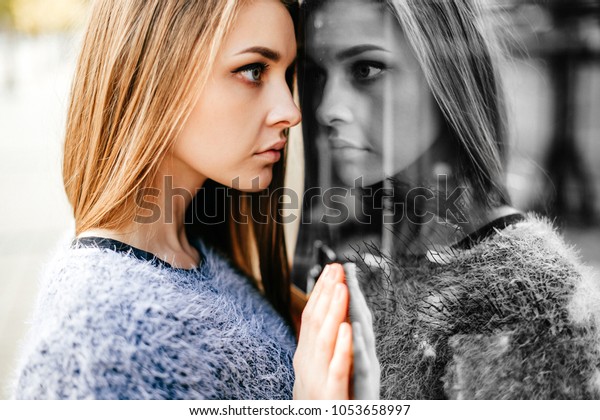
Self Reflection Portrait Amazing Young Girl Stock Photo (Edit Now)  1053658997
Unknown. “Self reflection portrait of amazing young girl in mirrored window. Unusual strange pretty woman person with sensual face looking at herself in showcase. Alter ego. Female state of mind. Other myself.” Shutterstock, Unknown, https://www.shutterstock.com/image-photo/self-reflection-portrait-amazing-young-girl-1053658997

I might not know how to start this piece, but I do know what I want to say in closing: (and if you did manage to read this far, I sincerely thank you.) The process of self-enlightenment is a painstakingly long journey, filled with many ups and downs, hopes that turn out to be worth nothing, and eyes widened in realization and understanding. This journey is frustratingly slow for a person like me, yet solemn and thrilling at the same time…I wonder where mine will take me?

*Cover Image Citation: Stäger, Raphael. “Eye Merging with Island.” InnerSelf, Unknown, https://innerself.com/personal/spirituality-mindfulness/religions-a-beliefs/3947-enlightenment-what-is-it-by-osho.html

Who am I? Societal Demands and Identity

Who am I? Societal Demands and Identity

When an individual without a secure sense of self grows up with societal demands, they may attempt to conform to those demands in order to be liked, leading to a journey of self-discovery.

“We become the people who are made by our family and society when we are ignorant of who we are.”

– Sunday Adelaja

Unknown. “Top 51 Quotes About Identity And Society.” Quotes STATS, Unknown, https://quotestats.com/topic/quotes-about-identity-and-society/

Somewhere, at some point in the near future, is me. Who is that “me”?

I suppose I should start figuring out who the “me” of now is first before I start looking too far ahead…

…but I can’t even figure out the answer to that myself.

Growing up where anything can be communicated with a click of the mouse, the push of a button, etc., the media has skewed a lot of individuals’ views on the “appropriate” social persona. What I’ve learned is that the appropriate social persona embodies traits like “honesty”, “authenticity”, “sincerity”, “bravery”, “selflessness” and “kind”.

What I’ve learned, in addition to that, is that likable people not only have the traits above but are also able to make friends easily. They’re friendly, lively, and passionate in all they do; the type of person who’d be patient enough to coax people out of their emotional shells and reveal those people to the world.

Now, I’m not saying that this persona is terrible. In fact, I know lots of people whom I admire that have at least one of those traits.

“Girl with Mask” by Rebecca Blair

There is, though, a silent pressure by society to embody those traits. I know I’ve attempted to become a better conversationalist, with the ability to talk about the new cake that a friend just made, or a book that they just recently read, or even just our surroundings, any random thoughts that they spout out. The rest is just wishful thinking.

In the past, I used to worry—thoughts pacing around in my head every time I couldn’t continue a conversation. Each time a conversation, with the potential for bonding, would crumble to dust because I couldn’t force anything out of my mouth. I would wish desperately that I had the courage to say something more—even just a comment would do. I detested my lack of conversational skills, wished I was more talkative.

That wish to be more talkative was why, for a very long time, I kept struggling to force conversation-starters and conversation-continuers out of my mouth, even if I wasn’t interested in the subject.

“My Life as a Thesis Statement” Visual

People will change and grow, like how day progresses to night, but like I soon realized, trying to change in order to be liked isn’t the way to live life. Recently, I have discovered that the reason I am so quiet during those broken conversations is that I’m deep down studying people, seeing if they fit me friendship-wise. It’s often never the other person’s problem; in fact, most of the time it never is. I’ve begun using what I thought was a lack of conversational skills to, in a way, test people. If they’re patient enough to stick by me despite all those halted conversations, then I can be sure that a friendship will begin to bloom that will last a very long time.

Back to the question from the beginning: Who am I now? Although I can’t say I know myself that well yet, I can figure myself out by observing the way I naturally interact with the world around me without letting societal demands tell me what to be like. That, I believe, will help me gain useful insight and ultimately lead me to discover who I really am.

Citations:

Girl with Mask: Blair, Rebecca. “Girl with Mask.” Pinterest, Unknown, https://www.pinterest.de/pin/361132463852675967/

Featured Image: Riches, Sara. “The Mask She Hides Behind Painting.” SAATCHI Art, Unknown, https://www.saatchiart.com/art/Painting-The-Mask-She-Hides-Behind/519729/2195580/view