Ignorance and Acceptance

Ignorance and Acceptance

In the short story “Cathedral”, Raymond Carver explores the idea of how close-minded individuals refuse to accept others’ opinions because they believe their beliefs to be correct no matter what. The narrator’s life has always been the same and he has never had any interesting experiences. When he meets people who are different from him, in this case the blind man, he treats them like complete outsiders without allowing himself to accept them for who they are. This makes him an overall very ignorant and pessimistic person. He has many prejudices towards blind people even though he has never met a blind person. The only way he was able to change his views on blind people was by stepping into their shoes and experiencing what life is like for them. This demonstrates how people are able to become more open-minded if they take the time to learn. 

Throughout the majority of the story, the narrator did not want to understand the experience of the blind man. When the blind man suggested that the narrator should help him draw a cathedral, he was confused at first because it was a strange request coming from someone he just met. After drawing the cathedral for a few moments, the narrator realized that the experience was different from what he had ever felt before and he was shocked when he realized that the blind man has lived like this his whole life. The blind man then told the narrator to open his eyes, but the narrator felt like he should keep them closed in order to fully understand what the blind man experiences. He was beginning to forget the previous prejudices he had and started to think open-mindedly. “So we kept on with it. His fingers rode my fingers as my hand went over the paper. It was like nothing else in my life up to now. … “Take a look what do you think?” … My eyes were still closed. I was in my house. I knew that. But I didn’t feel like I was inside anything.” The last part of the quote shows how he came to realize that he does not know what his life truly could be like. He recognizes that he has not had an interesting and fulfilling life like the blind man. Throughout his whole life, he thought that blind people have uninteresting lives. But after meeting Robert, the blind man, the narrator realizes that Robert has lived a more fulfilled life than himself, despite being blind. The narrator goes through an epiphany in which he realizes that his previous opinions and prejudices about blind people were wrong and that he was the one living the boring life.

“Cathedral” by Raymond Carver is written in a simple, minimalistic style which allows the reader to comprehend the story easily. The minimalistic style could represent the idea that despite being presented with simple explanations, close-minded people choose not to listen because the ideas go against their initial beliefs. They refuse to accept any opinion different from theirs because they believe theirs is correct. Additionally, the narrator’s epiphany occurring near the end of the story shows that it took a lot of time for him to even consider a new opinion. After all, he started to rethink his beliefs. It occurred after he experienced the blind man’s life first hand. Close-minded people often need to experience a situation themselves in order for them to feel any sympathy. “Cathedral” demonstrated the process of becoming open-minded in a detailed, and informing way which adds to the overall life lesson of the story.

Image Citations

https://www.vox.com/science-and-health/2017/5/15/15585176/motivated-ignorance-politics-debate

https://www.scientificamerican.com/article/when-the-minds-eye-is-blind1/

https://medium.com/the-mission/born-to-be-unhappy-how-we-can-overcome-our-own-biology-part-1-of-4-6def46457e8f

https://www.npr.org/2021/04/28/991700784/youre-probably-not-as-open-minded-as-you-think-heres-how-to-practice

A Meaningful life

A Meaningful life

My eyes were still closed. I was in my house. I knew that. But I didn’t feel like I was inside anything.

“It’s really something,” I said.

Final line when the narrator experiences an epiphany.

Raymond Carver’s short story, Cathedral, has a lesson that many people can take from. There is always good in every individual, and they can understand this not by their eyes, but by their heart. With that, they can choose their own path for they want to do with their lives, but this can only be done with a positive attitude rather than a negative one. Take the narrator for example: He is an ignorant individual that thinks highly of himself with a negative mindset. He is someone that can get jealous really easily and he doesn’t think about others. Due to this, the narrator doesn’t achieve anything that he’s satisfied with like his occupation and he lives his life with regret. On the other hand, we have the old man, Robert, that’s living his life to the fullest. Despite being blind, he found happiness in his life with a positive attitude and mindset. He didn’t let his disability stop him from what he wanted to achieve. Towards the end of the short story, Robert enlightens the narrator by having him draw a cathedral with his eyes closed. This leads to the narrator having an epiphany in which he can see what he is making with his eyes closed rather than having them opened. That is the lesson that I’ve learned from the story. 

In my life, I’ve always been told to get high grades, get good marks and I will have a good life. I feel like most of us have had this drilled into our heads at some point. I believe that we have to approach these challenges with a healthy mentality and we have to be motivated in order to succeed. We can see that with Robert in the story. He is a blind man but he got married, travelled, and despite losing his wife, he’s still someone who thinks positively. He doesn’t allow his disability to become a deterrent for his desires, and due to that, he lives a happy life. I try my best to become someone that is always positive but that can be challenging sometimes. I am often challenged by my parent’s standards in many aspects in life, but I try to change that by enjoying what I’m doing.

This can be compared to the narrator. As stated before; the narrator initially starts out as someone who is bigoted and ignorant. He experiences his life to be something that’s meaningless and there’s no purpose to it. The author creates this attitude through his sarcastic tone and humorous lines. Moreover, as we progress near the end of the story, Carver develops a sense of irony when the narrator experiences a spiritual awakening by drawing a cathedral with his eyes closed. Also, the blind man teaches him how to see despite being blind himself. Towards that end, he becomes someone who is enlightened to a new perspective of life which changes the way he wishes to live.

We can take this lesson from Carver and apply it to our own lives. We shouldn’t let anything stop us from living a meaningful life, and start by creating a positive lifestyle and philosophy. People who chase their desires without being pulled back by negativity are often successful and Carver shows that through Robert.

Image Reference:

AwakenTheGreatnessWithin. 2021. 4 Ways You Can Find A Meaningful Purpose In Life!. [online] Available at: <https://www.awakenthegreatnesswithin.com/4-ways-you-can-find-a-meaningful-purpose-in-life/> [Accessed 29 November 2021].

Paine, M., 2021. Notre Dame Cathedral Drawing – Michelle Arnold Paine. [online] Michelle Arnold Paine. Available at: <https://www.michellepaine.com/notre-dame-cathedral-drawing/> [Accessed 29 November 2021].

Nytimes.com. 2021. Stress Can Make You Sick. Take Steps to Reduce It. (Published 2019). [online] Available at: <https://www.nytimes.com/2019/10/08/well/mind/stress-can-make-you-sick-take-steps-to-reduce-it.html> [Accessed 29 November 2021].

First day of kindergarten

First day of kindergarten

School bus safety during the COVID-19 pandemic: 8 recommendationsWrite about your first day of school in kindergarten. Did it become better or worse than anticipated?

First day of kindergarten; it was a very long time ago. One of the only things I remember about my first day was getting on the bus. My mom had walked me to the bus stop and we waited together. When the bus finally came, the door opened and a very kind man, who would become a big influence on me, greeted me. I was the first stop so I was even more scared. I hugged her and ran onto the bus. I sat on the first seat on the right and waved to my mom as the bus started to pull away. I thought school was a scary but fun place and it can be. I met people pretty quick and was super excited about everything. I don’t remember many things but some stuff has stayed in my mind for years. I would say school is not what I thought it would be. I believed it was a simple place where you learn, have fun, and make memories. This is not wrong but it is so much more than that. All my life I’ve had a complicated relationship with school. Until high school it was never a safe place for me. Many different factors caused it to be an uncomfortable place for me. The older I got, the more I disliked school. I didn’t have many friends and I wasn’t very good at talking to people. I think school started much worse then I thought and through middle school things went further and further from what I hoped it would be like. However in high school, I made friends and learned more about myself and what I wanted which helped me enjoy school much more. This helped it become more like my dreams of what it would be like. Thinking back on it now, I don’t remember many things from school when I was younger. I remember some thing that had a big impact on my life but other than that, most of it flew over my head. Sometimes I think about the future and the fact that I will graduate in a year and a half but most of the time I felt depersonalized. It was more of a dream than my childhood. Often times I wish I had done more as a little kid but then I remember I still am a kid and have the chance to but I’m here wishing I did things in the past. All in all, at the end of the day it is almost what I expected it would be.

Ruins and Roses

Ruins and Roses

The ruins are the talk of the town. No one who has gone there has come back. Rumours spread. Some say they hear screaming, others insist they hear whispering amongst the crumbling walls. Perhaps it’s just the wind blowing through, rocks falling. But why does there have to be a logical explanation? Maybe the ruins are haunted. Maybe ghosts don’t exist; but maybe they do. Who’s to say? Regardless, people steer clear of the ruins. They whisper that they’re ruins peopled by ghosts who dwell there to taunt us.

Medieval Castle Eltz | Castle, Beautiful castles, Medieval castleA long time ago, the ruins were a magnificent palace. The princess used to live there with the man she had married until she ran away with the local witch. There were rumours about that too. Perhaps he abused her or perhaps she never truly loved him. After all, love works in strange ways. And it’s not as though she had much of a choice to begin with; her destiny was written long before she was born. Marry some fancy prince either for an alliance or for money. She never had the choice of loving another. Until she ran away.

No one really knows when the castle was abandoned. Most likely the princess’s husband left and never returned after she ran away. Then again, maybe he died there and it is his and his servant’s ghosts haunting the ruins. The only thing that was certain was that the ruins remained outside our town. And no one ever returned from them.

Or so the townsfolk think.

There is one person who decided to go to the ruins one day. She was bored of living the same monotonous life day after day after day. What was the point of life if not to explore and take risks?

Not to mention that her parents had her future all planned out. Finish school, marry “that nice boy down the street,” work in the fields and tend to the house, eventually become a mother in order to provide them with grandkids to spoil rotten. And, at the end of it all, Death would be waiting with his scythe in hand.

Of course, she had heard the stories. The streets of the towns were full of whispers; there was no escaping them. As a child, her parents had told her cautionary tales. Children are curious creatures by nature and the ruins pose a challenge, something new. A place to explore. But the cautionary tales worked, for children are also very impressionable. 

But as a teen, she was struck by a desire to know everything. The world seemed so vast and the town seemed so small and how was she supposed to find all the answers if she was stuck in the town? And the ruins were so close by. The rest of the world could wait; the ruins were a logical place to start. Perhaps she believed she could write her own destiny. Escape the chains of fate.

So she left.

There wasn’t one clear path to the ruins. Very few people had ever gone there, after all. The adventurer had to force her way through bushes, jump over puddles. She had thought that walking to the ruins wouldn’t take long because they were so close to the town, but it took hours. Perhaps it was some sort of enchantment; maybe the ruins didn’t want to be explored. Or maybe it was just a bad estimation of time. It’s hard to account for the obstacles that you can’t see at the beginning of the journey.

Eventually, though, she made it there. The sun was just starting to set, and it was the kind of sunset that made people stop in their tracks and look up at the sky with wonder, whispering to themselves or the people around them, “Wow, look how beautiful the sky is.” 

The ruins were right there.

They looked so much bigger up close than she could have ever imagined. It made sense, since the ruins had once been a castle, but the stories and whispers never really mentioned their size, leaving that to the imagination. What would’ve been the first floor of the castle seemed to be mostly intact, although there seemed to be some cracks and holes in the wall. Vines clung to the stone, as though they were the only thing holding up what was left of the castle. The pieces lying around the clearing where the ruins stood must have, at one point, been the upper floors and towers.

The adventurer walked up to one of these piles, feeling excited yet apprehensive. She couldn’t yet hear any screams or other noises that would indicate the presence of ghosts, but she wasn’t sure if this made her feel better or worse. In the pile of rubble, there were some pieces of metal and some pieces of stone that once upon a time had been intricately decorated. All that was left of these details were ghosts of markings. Since there was nothing really interesting in the pile, the only next logical thing to explore were the ruins themselves.

She walked into the ruins.

The room she walked into must have been grand, a long time ago. High ceilings, beautiful columns, intricate details along the walls. At one point there must have been art and carpets and a myriad of lovely things, but they were no longer there. Stunned, she stood for a few minutes, trying to take it all in. Never before had she seen something so huge. It seemed that the whole town could fit in this one room and there would still be space.

Then, the whispers started. Indiscernible, but it was clear that they wanted something. The adventurer was drawn from her trance, and, shaking her head slightly, decided to continue exploring. The whispers seemed to be coming from within, so she headed towards the door on the opposite side of the room. 

As she walked, the whispers got louder. They seemed to be speaking in a different language, though. Was this part of some sort of trap? Or were they whispering warnings? Who knows. The language of the olden days was long gone.

Indigo Rose Wallpaper | Blue roses, Blue flowers, Beautiful flowers

The next room contained a small table. Unlike the rest of the castle, this table was in pristine condition. Dust had not covered it and neither had vines. It was made out of some sort of wood and intricately carved. Bordering the table top were what seemed to be words, not words that the adventurer knew though. On top of the table, there was a vase, containing a single rose.

The rose was absolutely stunning. It was a gorgeous shade of blue, like the night sky had been captured and infused into the petals. The stem and leaves were almost an unnatural shade of green, but on the rose it looked stunning. Small water droplets covered its surface and its scent filled the whole room, reminding her of the flower fields in the spring. 

The whispers had gotten louder, almost deafening.

But the rose was gorgeous and she was curious, so she reached out and grabbed the rose. Immediately, she sank to her knees, limbs shaking, a scream emitting from her throat. Her vision filled with images. A man sobbing as he stabbed his wife. A woman crying at the table after finding out her husband had cheated on her. A child being slapped by his mother. More and more images flashed faster and faster. There was no escape.

It seemed as though all the agony and pain that had ever existed in this wretched world had been stored in this one blue rose.

Eventually, after what might have been minutes, or might have been years, the images slowed, and then stopped completely. The adventurer’s voice was hoarse from all the screaming and she lay on the floor, crying. When she realized that she was still clutching the blue rose, she threw it as far away as she could and, using the little energy she had left, started crawling away.

The whispers came back, filling her head, forcing her to stand up, for she couldn’t stand the noise. She wanted to run, far away from this place and from the terrible rose but all she could do was put one foot in front of the other. Slowly, oh so slowly, she walked out of the palace.

Night had overtaken the world, and the only light was that of the moon. Even in the darkness though, the adventurer immediately noticed the unmistakable blue roses that now covered the ground. The scent of the roses filled the air and she screamed. She tried to run, she really did, tried to get away from these cursed roses. But as she ran, the ruins didn’t get any further nor the town any closer. It was as though she was trapped. 

It would’ve been so easy to stop.

But she didn’t stop. And eventually, whatever enchantment had kept her running in one place seemed to give in. The town grew closer, the ruins farther. Yet even as she ran, the scent of roses remained. The adventurer looked back and saw that the bushes that had been empty on the way to the ruins were now filled with blue roses. She sobbed and ran faster. 

There was no escape from the scent, from the colour, from the perfect petals.

She made it home, somehow. No longer did she want to explore the world. It was a cruel place, what more was there to know? Perhaps fate had played this cruel trick, making it seem as though there was an escape, when in reality, there was only one life for a townsperson. Finish school, marry “that nice boy down the street,” work in the fields and tend to the house, eventually become a mother in order to provide her parents with grandkids to spoil rotten. And, at the end of it all, Death would be waiting with his scythe in hand.

At home, it seemed that almost no time had passed. No one had noticed that a person had left and came back. And it would stay that way. There wasn’t any reason to tell anyone about the ruins. The townsfolk wouldn’t have believed it anyways. So, once again, destiny had won.

To this day, I can’t stand the sight of blue roses. For I was the one who went to the ruins.

Image Sources:

featured image

castle

blue rose

Stereotypes vs. Reality

Stereotypes vs. Reality

     A stereotype is a “widely held but fixed and oversimplified image or idea of a particular type of person or thing.” These are often held in everyone’s mind and are often made in split seconds. Stereotypes place expectations on people about how they should act, what they should do, and how they should look. These often go against reality which is “the world or the state of things as they actually exist, as opposed to an idealistic or notional idea of them.”  The two often come into conflict in our everyday lives and this clash is also indicated in the short story “Cathedral” by Raymond Carver. The author expresses a theme of how viewing reality can change stereotypes. 

     The author reveals that when an individual takes the time to get to know someone, the pre-existing stereotypes that they may have had will be broken and replaced with an accurate indication of who the other person is. Raymond Carver uses the interactions between the narrator and Robert, the blind man, to show this. In our society, we often don’t have or think we have, the time to get to know someone for who they are. This can result in us making snap judgments of people and creating molds or stereotypes for who they “must be” based on what we figured out about them in the two seconds we interacted with them. We can even create stereotypes of people based on things we hear or see about them in forms of media like television or social media. These little interactions can heavily influence how and what we think of them. This was seen in the short story when the narrator was talking about meeting the blind man and later when he was smoking with him.” My idea of blindness came from the movies. In the movies, the blind moved slowly and never laughed. Sometimes they were led by seeing-eye dogs.” and “I remembered having read somewhere that the blind didn’t smoke because … they couldn’t see the smoke they exhaled.” The narrator had already made a stereotype of what the blind man should look like based off of some movies that he watched and something he’d read somewhere. If he had taken the time to talk to and get to know a blind person, he would most likely realize that both assumptions are false. But he decided to believe what some other people told him instead of coming to his own conclusion. However, the more he talked to Robert and the more they interacted with each other, he began to see how wrong he had been. Robert didn’t wear black sunglasses, he smoked, and didn’t have a seeing-eye dog. He even watched coloured television!! Robert helped the narrator realize what he had been doing for quite some time. He had been creating these quick judgments of people or things his whole life. When he paid attention to who or what they really were, it allowed him to gain a deeper appreciation and understanding for all the intricacies that he hadn’t really seen before like with the Cathedral. He didn’t know much about it simply because he thought they were just something to look at on late-night TV. But when he started to describe them to Robert, he realized that there was so much more that he was missing. The blind man helped the narrator see the world for what it truly is by removing the stereotypes he had in place and opening him up to reality.

     I have seen the clash between stereotypes and reality firsthand in my own life, being both the “stereotyper” and the “stereotyped”. Whenever I’m out and about around the city or interacting with other kids my age through cadets and camps, I see people that I don’t know. I frequently find myself looking at them and making a mold for who I think they are. However, when I interact with them I realize that my guesses are almost always wrong. Looking back, it made me think about all the times I unintentionally made stereotypes of others. Could they have been doing the same thing to me? As a society, we tend to go about our day with our goals and wishes in mind without time for many other things. This little time results in more and more quick speculation and judgments on who other people are. However, if people took even 5 minutes out of their day and talked to someone new, it could result in them breaking the stereotypes they had made about the other person. This would most likely result in a society becoming closer and creating a sense of unity. People wouldn’t fear the unknown because they would know who the people they live around are.

     Growing up in an Indian family and being a lanky Sikh with a turban, I’ve seen and experienced my fair share of stereotypes. I didn’t really see them for what they were at first, but as I got older they became more and more apparent. Whenever I met new people at school, summer camps, and sports teams, they were often surprised when I told them that I was a Sikh. Many were even more surprised when I told them that I played competitive sports. When I was little, I just laughed at them and didn’t really understand why they were surprised. However, when I got older and began to inquire why, I got answers that surprised me too. When I asked why they were surprised I was a Sikh, many said that they had thought I was a Muslim. When I asked why they had been surprised that I played sports, many said that I just didn’t look like I did because I was so skinny. Some even said I looked “nerdy”. I came to the conclusion that they had made stereotypes about me before we had met, and I had made some about them without even realizing it. However, the more I interacted with those other people and the more they saw me for who I really was, those stereotypes began to fall apart. They were replaced with better understandings of who we all were, which further expanded and improved our senses of reality, 


IMAGES:

https://www.spsp.org/news-center/blog/are-stereotypes-accurate

https://www.sleepfoundation.org/dreams/can-blind-people-dream

https://www.dreamstime.com/royalty-free-stock-image-volleyball-basketball-soccerball-row-team-sport-game-concept-isolated-white-image33363896

Choosing a Fate Out Of Our Reach

Choosing a Fate Out Of Our Reach

When we are forced to make decisions which will heavily impact our futures, we become conflicted between fulfilling our own desires or serving the expectations that others have for us. We end up in the middle of this battlefield where societal expectations and personal desires are in a clash with each other, leaving us unhinged and not knowing what to do.In Yasmin Marri’s Poison of The Blue Rose, the author exemplifies the internal conflict in our minds between making others happy over making ourselves happy. Yasmin Marri also illustrates that when an individual is faced with a heavy decision to make, they may choose to conform, resulting in an inner conflict.

Being loyal to the expectations those around us have and being loyal to our own desires are two sides of a spectrum where, sometimes, an individual cannot find a middle ground. Gulab Bibi is in love with and wants to marry a man named Rafiq. Until now, she had been fantasizing about a marriage with Rafiq and how it would make her really happy. She knew she would feel fulfilled if she marries Rafiq. The issue arises when Gulab Bibi’s parents have her engaged to someone else, and Gulab Bibi decides to tell her mother about Rafiq after the fact. This causes an internal issue in Gulab Bibi and she becomes overwhelmed with all this emotion and simply doesn’t know what to do. On one hand she wants to keep her parents happy, but on the other hand she wishes to break free from their expectations and do what her heart wishes for.

In the end, she gives in to what her parents wish for her. Her desire shatters and she realizes that she can’t change what is happening. Although individuals can be discontent with their circumstances, it may be for the better if one looks at the conflict from another angle. Gulab Bibi accepts what is happening, and decides that she can’t marry Rafiq. Our realities are constantly being shaped by our actions and what we believe is the right course of action. The internal conflicts that arise from this may become a heavy burden, causing us to give into others expectations. In the end, we accept what is being laid out for us and decide to not make things worse than they already may be.
Gulab Bibi, having accepted her fate, returns to the narrator’s home a few months later with a love letter from Rafiq. Although she is ready to be wed to the other man and has made her mind about that, she can’t seem to forget Rafiq. Individuals who are forced to choose against their wishes end up conforming and decide to uphold others expectations. They then, although forced, also agree to what is being laid out for them. But memories and reminders of what could have been can hinder them and plant a yearning in them again, a yearning for the fulfillment of their desires. Although the narrator is trying to convince Gulab Bibi to leave this platform of life, Gulab Bibi still has a clinging feeling to Rafiq, but goes through with what the narrator tells her. Gulab Bibi felt that she was making the wrong decision, and even after she accepted the fate her parents had for her, she still felt weird about it. Nonetheless, she gave up her personal desires to make others happy.

Gulab Bibi is a visualization of the concept of man vs. society. Yasmin Marri properly illustrates this through her character, but also mentions that no one can run from their past. Gulab Bibi inquires about the narrator’s past, which brought the narrator back to that platform in life where she had been running away from. Then we see how the narrator struggles with a similar situation where she also gave up her personal desires to marry a man she didn’t know. Both Gulab Bibi and the narrator were forced to make decisions that left them unhappy. But under the pressure of not disappointing others, they went through with it not realizing they shattered a piece of themselves, the piece with the strongest desires.

References: (images)

“You Probably Won’t Like The Real Reason Your Partner Is Pulling Away”. Women’s Health, 2021, https://www.womenshealthmag.com/relationships/a28555974/why-men-pull-away/.

“What Is The Rarest Color Of Rose? | Plant Addicts”. Plantaddicts.Com, 2021, https://plantaddicts.com/what-is-the-rarest-color-of-rose/.

“Silhouette Of People Yelling, HD Png Download(632X640) – Pngfind”. Pngfind.Com, 2021, https://www.pngfind.com/mpng/iwTRJi_silhouette-of-people-yelling-hd-png-download/.

Openminded

Openminded

The expression, “don’t judge a book by its cover”, is a metaphorical phrase meaning an individual should not judge the worth or value of something by its outward appearance alone. This idiom is generally referred to when discussing equality as it is unfair to make assumptions about an individual based on only their exterior traits. To demonstrate equality, one must put forth their best effort to ensure that every individual, regardless of race, religion, disability, etc., has an equal opportunity to make the most of every situation. The theme of equality is apparent in the text, “The Cathedral”, by Flannery O’Connor. In this short story, the narrator assumes that all blind people are the same; As a result, he is consistently proven wrong. The narrator is continuously surprised by the blind man’s normalcy; the man has a beard, doesn’t wear dark sunglasses, smokes, and easily navigates his meals. Therefore, the narrator was extremely incorrect in regards to his stereotypical assumptions about his blind guest. By writing, “The Cathedral”, Flannery O’Connor disproved common stereotypes that are often associated with physical differences. Due to this, equality is a consistent theme throughout the piece as it demonstrates the fact that you can not make assumptions about people based on society’s stereotypes. Therefore, the main theme present in this short story is equality, as well as the open-mindedness to act in such a way.

CRACKED.com — Source material aside, did you find yourself...

The intention and impact of honesty on an individual’s life and the power an individual has to create a meaningful life are two prompts that connect to the short story, “The Cathedral”. The text tends to circulate around how false ideas and assumptions affect an individual’s point of view and suggests that we all must make the best of every situation. This is demonstrated through the narrator’s constant bewilderment regarding the blind man’s way of life as it is not necessarily the stereotypical life of a blind person. Despite his disability, the blind man lives a happy and fulfilled life, looking at every situation with an optimistic perspective. He says things such as, “I’ve got ears”, when asking people to describe physical things to him. The blind man has such a positive outlook on life that the story becomes ironic in the sense that the man who can see learns things from the man who can not. The narrator learns the importance of being open minded and inclusive despite the outward appearance of someone or something; he learns that true joy exists within making the most of any situation. The intention of honesty is a crucial thing for all circumstances as truth is what allows us the ability to build connections with one another. Although honesty with others is very important, honesty with ourselves should be a priority as we are unable to be open minded without being truthful with ourselves. Being honest with oneself is more complicated than it may seem, as an individual rarely resists the temptation to fall victim to believing society’s stereotypes, tainting one’s view of the world around them; instead, an individual must ignore stereotypes and vouch for themselves. Once an individual has achieved the talent of open-mindedness, they’ll have the ability to set their mind to anything and live their desired life. Everyone has the power to create a meaningful life for themselves, it simply comes down to being open minded and honest. The blind man demonstrates this to the reader through his honesty with himself as he has come to peace with the fact that he is without the ability to see, instead, he makes the best of his situation and relies on his other senses to live his life; regardless of his disability, the blind man has lived a happy and fulfilled life.

Therefore, equality is a consistent theme throughout the short story, “The Cathedral”, as the text describes the narrator’s initial surprise at the lack of applicable stereotypes in regards to his blind guest.  Throughout the story, the blind man teaches the narrator the importance of being honest and open minded, ultimately teaching him how to create a meaningful life. The narrator’s originally biased perspective is altered as a result of meeting a blind man who doesn’t fit into the standard stereotypes regarding disabled people. As a result, he learns the very important lesson of open-mindedness.

The Great Need for Personal Fulfillment

The Great Need for Personal Fulfillment

“Personal fulfillment is a need, not a luxury.”

The above quote is one that I just so happen to agree with. Life is both long and short. Our time here is limited and filled to the brim with hardships [the world small and its struggles many]. And if we are to be completely honest, little of what we do will be remembered or important when the reaper comes with scythe in hand. Yet life also finds ways to drag on, like the great wheel of time is pushing forth through mountains of sand. For the reason previously stated, life seems to take a more monotonous tone. Perhaps it is this mundane feeling that gives us the arrogant and naive feeling of immortality and that we have all the time in the world. It’s a fine line we walk really, can’t tip too much to either side. So anyway, life is too short to waste a moment doing nothing and too long to spend it wasting away with no joy. Therefore this would mean that personal fulfillment is necessary for one to truly live. Personal fulfillment is when an individual strives towards their goals and chooses to achieve them. One must have this type of drive or else they will be lost in what to do. Life would pass them by without them ever even noticing or accomplishing anything they wish. As was said before, we have a limited time here so nothing related to the real meaning and depth of our lives could be seen as a “luxury”. It is a need for personal fulfillment, something we must chase after so that we can look back and say that we can enjoy life and essentially prove to others that we were alive. 

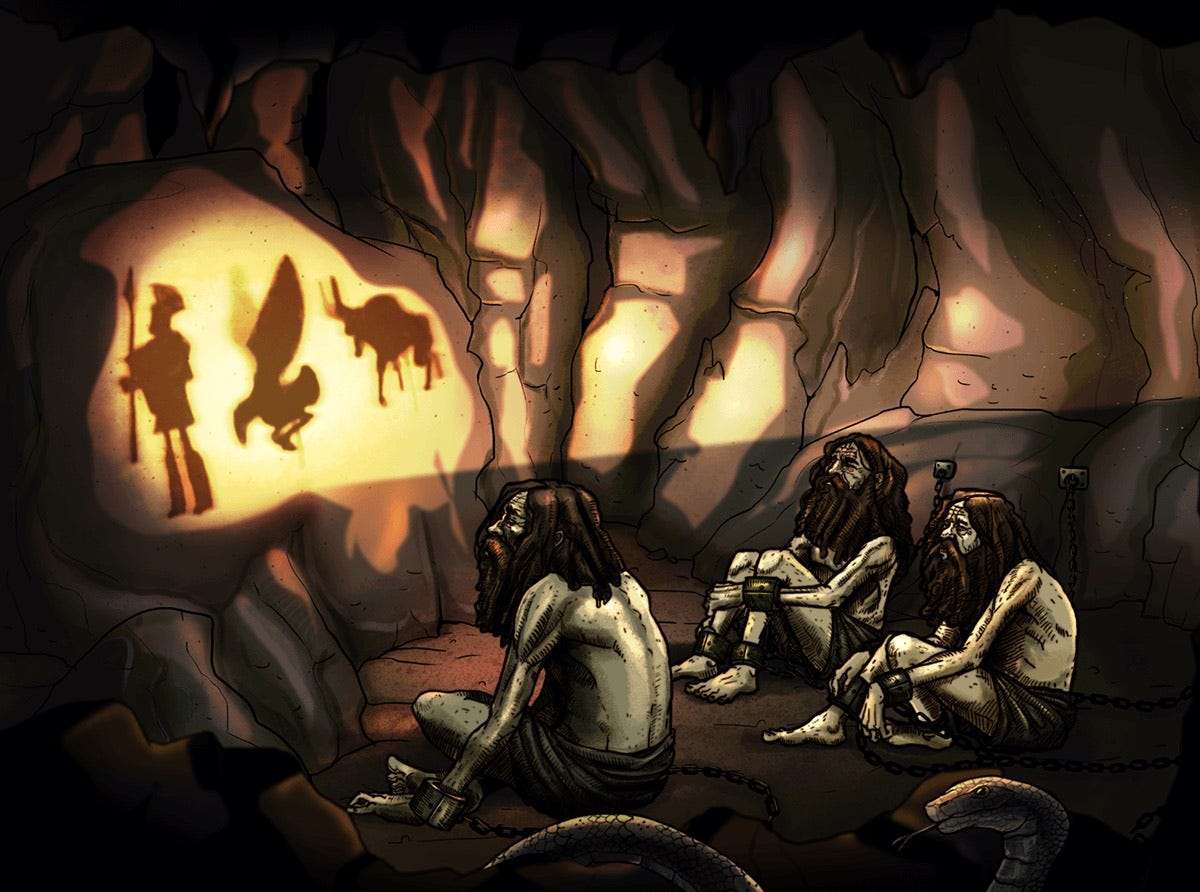
 Even in the Allegory of the Cave written by Greek philosopher Plato, one can see that fulfillment is a great need of the people living in the cave. We can infer that they don’t comprehend death as they have never seen it before, yet they still have that need to learn about the world as soon and as much as possible. The one that leaves the cave has only experienced a small fraction of what the world has to offer but he already understands that he must seek more knowledge and relay these new discoveries to his comrades in the cave. This is his need to achieve fulfillment in his life, his need to satiate his newfound thirst for knowledge. Subconsciously he must feel the tick tick tick of time passing which, mixed with his own personal desires, pushes him forward. This man is the closest one could ever get to observing a human acting without outside influence, meaning that his actions prove that we have the innate sense to seek personal fulfillment in whatever form it may be. Although his reactions to the world also represent how such a goal takes time. 

“Under that light, would his eyes not be nearly blinded, unable to discern any of those things that we ourselves call real? … It would take time, I suppose, for him to get used to seeing higher things.”

One can not handle the full force of the sun at once just as they can not handle the full force of enlightenment and the need to achieve their goals all at once. It takes time, which ties into the fact that life is as long as it is short. See, if we were able to achieve personal fulfillment quickly, then that would defeat the purpose of actually enjoying the journey to achieve it. Let alone the fact that it is a heavy burden to bear all at once and takes a while to complete to a satisfying degree. 

So, based on the Allegory of the Cave one can conclude that personal fulfillment is a need, not a luxury. It is what helps us find the balance between living long repeating lives that are also doomed (blessed) to end. If we are born to die then we must focus on living full lives while we are here. Otherwise, we would go mad, too preoccupied with the thoughts of death. 

Citations:

https://pin.it/1gbtJ3O

https://www.thedesertreview.com/opinion/columnists/millennialmeltdown/carrying-the-weight-of-the-world/article_532277bc-6653-11eb-8f0f-ef4fdc3584e8.html

https://www.drawingskill.com/art/17595

Santa Claus

Santa Claus

Santa Claus, the symbol of Christmas and gift-giving. As children, many of us would spend the year trying to be good, leaving a plate of cookies and a glass of milk under the tree to await the welcomed visitor. For many years, the thrill of the morning awakens us from our slumber, drives us down the stairs and to the base of the Christmas tree. Years and years go by until we finally start to question the validity of Christmas.

The Allegory of The Cave: How It Still Matters When it Comes to “Fake News” | by Nicholas Martinez | Medium

As a child, I grew up believing in Santa as a result of the superficial reality that arises from the naivety and ignorance of youth. Childhood is similar to the cave in that children often accept what is preseted to them, for they lack the knowledge needed to question what they see, similar to that of the prisoner. I was imprisoned by the impressions I made from my limited knowledge of the world; I saw what was present and took it to be true. But, as I started to get older and started to get more knowledge I was able to reflect on the validity of Christmas, looking towards the light, and meeting it with pain and confusion. I had been so entranced by the presence of Santa Claus that when I found out that he was simply an illusion I had a hard time believing in this newfound reality. I found comfort in what I grew accustomed to and had little desire to part ways with it. I was perplexed by the fact that I had spent the better part of my life believing in something that was not true, like the prisoners with the shadows on the wall.

The Allegory of the Cave

Eventually, a time came where my parents explained to me that it was, in fact, them who had been leaving the presents, eating the cookies, and drinking the milk. I had a hard time accepting this to be true. After all, the depiction of a large, jolly, man clad in red was appealing to an 8-year-old boy. As a result of being brought into the light, I had entered a defensive mood, one where I shut down any attempts of reconciliation. Instead, I chose to ignore the thought of Santa’s unreality, I found feelings of uncomfortably and pain when thinking about it. I fancied the shadows to be truer than the object that was revealed to me by my parents. This process stemmed from my familiarity with Santa Claus. I had spent eight years waking up on a specific morning every year, running downstairs to find that the cookies had been eaten and the milk had been drunk, and in return for my good behavior he had left me a present. People around the world take comfort in that which they are accustomed to, they have taken the shadows to be true, never seeing anything else. They find the shadows appealing for that very matter, for when you introduce the idea of the objects or the world outside of the cave an ignorant individual will find comfort in consistency. 

The Allegory of the Cave by Plato (Excerpt from The Republic) - YouTube

After a few years, I was constantly exposed to the fact that Santa was not real because of my fellow classmates who had also been enlightened. This constant exposure to the light, that being Santa’s unreality, forced me to grow accustomed to it and realize the foolishness of my reluctance. As a result of my acceptance, I began to question the validity of other aspects of my life. Looking back on the things I thought to be true and wondering if it was a result of my own ignorance and limited knowledge of the world.


Citations

Martinez, N. (2019, March 1). The allegory of the cave: How it still matters when it comes to “fake news”. Medium. Retrieved November 29, 2021, from https://medium.com/@nicholasamartinez732/the-allegory-of-the-cave-how-it-still-matters-when-it-comes-to-fake-news-810b391a3e88.

McClure, S. (2014, November 17). The allegory of the cave. BlackBerry ThreatVector. Retrieved November 29, 2021, from https://blogs.blackberry.com/en/2014/11/the-allegory-of-the-cave.

Reactions, A. (2015, June 1). The allegory of the cave by Plato (excerpt from … – youtube. The Allegory of the Cave by Plato (Excerpt from The Republic). Retrieved November 29, 2021, from https://www.youtube.com/watch?v=UchtCa1uQqk.

Unknown. (2019, December 24). The history of Santa Claus – from 123dentist. 123Dentist. Retrieved November 29, 2021, from https://www.123dentist.com/history-santa-claus/.


To be young again

To be young again

Response to- Half a Day 

*Journal 26*

Quote:

“As our paths revealed itself to us, however, we did not find it as totally sweet and unclouded as we had presumed.” 

I chose this particular quote as my response because it is one of the many feelings that I have developed over the past few years. We have all been little children wishing to be one year older, and when that day arrives, we start another countdown till the next yearAlliance for Childhood – A healthy childhood for every child. I anticipated and loved the idea of being older. Seeing adults have the freedom to do anything they wished was what initiated my longing to be older. I believed growing older was all about going out with friends constantly, being able to drive, and having the freedom to be anywhere I wanted. At age 11, I couldn’t wait to be 13, at 13 I could not wait to be 16 and now at 16, I wish I was 11 again

 I always imagined that the older I got, the more fun and freedom I would get, but I forgot to notice the number of responsibilities that came with growing up. Due to being oblivious to this truth, when it came for me to start taking up these responsibilities, I felt unprepared and cheated out of the fantasies I had created for myself. Although growing older yields more freedom and memories, I find that life gets more complicated and scary. 100+ Stress Pictures | Download Free Images &amp; Stock Photos on UnsplashAt age 11, the only “stressful” obstacles were mundane things like choosing what outfit to wear on casual days, but now I realize I have far more difficulties than that. I now have the responsibility to determine my future. Looking back, life was sweet and joyful, but now it’s more bitter-sweet. I find that I get anxious over every little thing now. Which career should I choose? Is it the right path for me? What should I do about post-secondary? All of these questions are just examples of the many thoughts I’ve had but haven’t been able to answer. School especially has become more of a chore than someplace fun. When I was younger, I loved going to school just so I could see my friends and play around. Now school seems almost like a do-or-die situation. Every decision now will lead up to my final decision in the next 2 years. I wish I had enjoyed those years when I had almost nothing to worry about. 

The constant moving of life is inevitable. Perhaps ten years from now I will be looking back to when I was 16 and realize I had fewer responsibilities than I thought. There will be new obstacles in each phase of my life, that I know for sure. With this knowledge, I strive to take advantage of every moment now and enjoy it. Oddly, however, I cannot wait to keep growing. The idea of being an adult and having that freedom still entices me but now that I know I will definitely have more responsibilities as I grow older, I feel a little more prepared about the future. Insight: What is life? - Newspaper - DAWN.COMThere will always be the sweet and joyous days and there will always be the bitter and clouded days. I believe one of the main points of growing up is learning how to use the memories of good days as a source of motivation when bad days roll around.