Poetry Seminar Responses

The Land of The Free” – Response to Let America Be America Again by Langston Hughes

Is America Really the Land of the Free? | Redefy Stories

Photo Link: https://www.redefy.org/stories/is-america-really-the-land-of-the-free

America. The land of the free.

That is what we set out to be.

But the American dream was an American nightmare

It turned out to be a nightmare, indeed

We pledge allegiance to the flag

We pledge liberty for all

But where was that pledge

When you watched us fall?

The only stars we saw in the sky were on the flag

Of the country that imprisoned us

They bruised and beat down all of our own

How did we call this our home?

Why do we call this our home?

It is our home as much as it is yours.

Our blood and our tears watered the crops

Filled the rivers, stained the streams

That sustained this so-called land of the free

But this land of the free did not sustain me

The land of the free. What does that mean?

And why can’t those called the free include me?

What was my crime that caused me to be chained?

Was I guilty of being? Guilty of breathing?

Nobody chose to stand up for me. 

But now I ask you to stand up with me.

With all for freedom comes freedom for all

A true freedom that lasts. A freedom that matters.

From the mountaintop to the big city

From the Great Plains to great rivers

Regardless of culture, race, or colour

From the rich to the poor

An America where everyone can be free. That is all I ask for.

This is a poem responding to the poem “Let America Be America Again” by Langston Hughes. My response starts off by introducing this notion of America being the land of the free. However, without naming a particular group, the narrator starts introducing the idea that it is not truly free. Much like the poem I was responding to, I decided to not assign an ethnicity or minority to the narrator in order to keep it relatable for all of the oppressed.

“The Same” – Response to We Shoot Children Too, Don’t We by Dan Almagor

Here's What Plan B in the Middle East Should Look Like | The Washington  Institute

Photo Link: https://www.washingtoninstitute.org/policy-analysis/heres-what-plan-b-middle-east-should-look

We are the same. We are all the same.

We bleed, sweat, and breathe same.

The difference is we’re better simply because we are

We have the right, it’s our duty.

But what divine being gave us the right,

who, what, gave us the right

to laugh at their shrieks, to their screams,

are we really defending when we do these things?

Why do we raise our weapons against the weaponless?

This is not right.

And now we teach children to take up our fight.

Is this right? Is it not wrong?

That we teach ours to shoot theirs for singing their nation’s song?

Why do we teach them to throw stones and bombs at others?

They should throw stones to skip along the river

where now blood flows, human crimson streams

which carry their dead’s broken dreams

The dead; men, women, and children who lived.

Do you think our actions can be forgived?

When people die, children cry

but why don’t we cry when children die?

This is a poem responding to the poem “We Shoot Children Too, Don’t We”. This was a very impactful poem showing the sense of humanity lost in the conflict ensuing between Israel and Palestine. Criticizing Israel’s actions against the people of Palestine, the poet demonstrates that we are all human. Through my poem, I attempt to encapsulate the same basic principle; we are all human and deserve to be treated as such.


The Duality of Ambition

ambition, Photography, Reflection, Chess, Mirror, Xatwn, Piramerd  Wallpapers HD / Desktop and Mobile Backgrounds

When people have ambition, they have the strong desire to achieve success. It motivates people to become something they see as greater than themselves. It is a force that helps them picture what they want to be in the future and motivates them to chase that version of themselves. Ambition may help motivate people to become better than they are, but it’s danger is in the extent effort is put into completing their goal. Ambition is great in motivating people but if paired with high expectations, people can fall prey to the idea of quick success and that eventually leads to their downfall. In the short story, ‘Two Kinds’ by Amy Tan, the author presents the idea that when an impatient person starts off highly ambitious with equally high expectations, they work extremely hard at the start, however, if they do not achieve the results in a short amount of time, they get discouraged and frustrated leading to them quitting and losing their ambition and their sense of their potential.

Failure a stepping stone to success

Typically, a person’s imagination can empower their ambition and lead to them dreaming of grandeur or greatness. These goals and these imagined scenarios lead to high expectations of themselves. People who act on ambition often start off extremely motivated and work as hard as they can in order to try to achieve their goal. Their ambition pushes them to do as much and whatever they can to reach what they see as their highest potential. Easily excitable, they are filled to the brim with motivation and aim to do whatever it takes to make it to that point. People love the idea of achievement and can become so obsessed with it that they simply chase success without really thinking. 

“I pictured this prodigy part of me as many different images, trying each one on for size.”

Jing-mei is given this idea of her being perfect. She imagines a world where she was a prodigy and it ramps up her expectations even more. This increases her ambition and her motivation to become a prodigy. Through becoming a prodigy, she thinks she would make her parents proud and would be perfect. Individuals believe that through extremely hard work and pure determination, they can accomplish success quickly and without too much of a hitch. This in turn motivates them even more and they begin doing all that they can in order to improve themselves. This can be very beneficial to a person’s growth and may help them become a better version of themselves. Eventually, they face their first obstacle or their first failure. Their reaction dictates the results of their ambition. If they are motivated enough to keep going, they keep going and it leads to self-growth. For some people, they are flattened by failure and are immediately unmotivated.

Failure and obstacles are not a bad thing. In fact, they should be expected and embraced. Impatient people with high amounts of ambition have as much motivation as any other person, perhaps even more, and they try to overcome every obstacle through brute force and effort. However, even with all of their ambition and hard work to start it off, if the bar is simply too high in a too short amount of time, they may get frustrated if they are too impatient. When they encounter their first roadblock or failure, they are confused because they are working so hard. Expecting better of themselves or more, they are very disappointed with the final result. It may take more time for them to develop their skill and they do not feel as if they can become the person they want to be. They begin to get mad at themselves for not reaching their goal immediately, despite their hard work. It may be more difficult than they previously thought. To add to all of this, they feel a sense that their opportunity to be great is fleeting. Jing-mei experiences this through the prodigy side she sees in herself pushing her to hurry up. As a child, her mother tries to bring greatness out of her and she is given more tests.

“But sometimes the prodigy in me became impatient. “If you don’t hurry up and get me out of here, I’m disappearing for good,” it warned. “And then you’ll always be nothing.””

This realization that they are not yet what they wanted to be causes all of the expectations that lifted them up and motivated them to be great to crash down because they were expecting greatness. All they got was a bitter failure or a half-success.  This high amount of but also rushed effort only results in what they see as a mediocre result, causing them to be dissatisfied with their progress. Failed expectations lead to doubt in themselves and their ability to become what they want to be. Sometimes, this doubt begins to creep up on a person. Failure to meet their expectations makes them feel inadequate. This inadequacy they feel drains them of what is left of their motivation.

How to Find Balance When Too Much Self-Doubt Gets in the Way | KQED

Motivation is easy to gain and hard to act on. It’s even harder to maintain. High expectations that eventually are not met in a short period of time lead to doubt. They not only doubt their ability to achieve the goal they are pursuing but also begin to doubt themselves as well. Individuals begin to doubt their ability to be great and this doubt eliminates the motivation they had at the start. Their intense motivation at the start is immediately diminished. Sometimes, they not only lose motivation to pursue their goal but they also lose motivation to improve themselves as a whole. The failure not only causes doubt that results in little to no motivation but it also can be quite demoralizing and detrimental to one’s perception of themselves. In “Two Kinds”, this is shown through Jing-mei’s gradual acceptance of her normality and her perception that she cannot be more. After her argument with her mother and her comment about her mother’s dead children, Jing-mei reveals that her failure as a child playing the piano and her constant mindset that she could not be more than herself affected her in her later life. She allows the shortcomings she experienced in childhood to affect her future decisions.

“In the years that followed, I failed her so many times, each time asserting my own will, my right to fall short of expectations.”

Jing-mei is unable to motivate herself to be more than who she is now. She treats it as if she had simply accepted herself. Self-acceptance is great and being able to love who one is is important and both can be lost in too much ambition. However, Jing-mei has not really accepted herself causing this ability to accept who she is. It is less self-acceptance and more of her giving up on herself. She gives up on trying to be better than what she thinks she is and puts little to no effort in anything. This leads to an empty and discontented life where Jing-mei simply does what she can rather than broaden her horizons. Her belief that “I could only be me.” is her declaring her belief that she can only be who she is currently. This belief hinders her ability to grow. Sometimes individuals can give up on themselves and that can be dangerous. They may feel as if they have hit their ceiling and use it as an excuse not to try. This acceptance of their current self is not self-acceptance but rather self-denial, using their current limitations as rationale. They stop trying to improve themselves because they have lost hope in their ability to pursue their goals.

Classical virtuoso loses 'best friend' as movers drop $200,000 piano - BBC  News

I experienced this in my personal life as a pianist. While I do not take lessons anymore, I still try my hardest to improve when I can and I have struggled with too much ambition leading to too little ambition. Ambition and how much of it you have is a very powerful motivator when it comes to trying to improve oneself. In piano, I always strive to be better than I am now and I try to learn how to be a better pianist. I practice regularly and (used to) take lessons in order to learn all of the skills I need to succeed. The teachers provide me with sheets so that I can learn pieces that gradually improve my skills as a pianist. Sometimes, however, I find myself getting too hasty. I see how others succeed in the field and feel that my own skills as a pianist are inadequate. I want to be a much better pianist and I am motivated to improve even more. This zeal for being a better pianist does give me the energy and motivation I need to improve but this also leads to me setting high expectations for myself to achieve. I want to improve exponentially so I choose to try to learn pieces on my own with little to no guidance. Not only do I choose pieces and aim for quick improvement but sometimes I also choose ones that are significantly harder than my skill level can handle. I fail to realize that pieces that are too hard do not always lead to improvement but lead to frustration and failure to the point that I end up giving up. My motivation is drained because of the failed expectations I had set. Feeling empty and regretful because of my failed expectations, I tend to try and learn easier songs in order to try and make up for the failure. Doubt stops me from trying anything harder than my skill level and sometimes I even choose to learn pieces easier than what my skill level can handle in order to try and make up for my failure. The lack of moderation in my ambition leads to either too much stress or too little courage.

Ambition is neither a good or a bad thing. It is simply a motivator for actions, both good and bad, to be taken. It encourages people to pursue their personal goals and wants. With ambition, people can be very successful and set themselves up to achieve great things. However, too much ambition can lead to an unhealthy pursuit of the goal where motivation from ambition can lead to an extremely challenging goal that gives a person high expectations. When the high expectations are not reached due to little preparation or a lack of time, people lose hope in themselves and their ability to be successful in what they are pursuing. This leads to the exact opposite of how they started off; they end up being unmotivated and have too little ambition. This little amount of ambition ends up making them feel like they have little to no potential, giving them justification to refuse growth.

Chess Ambition Photo: https://wallup.net/ambition-photography-reflection-chess-mirror-xatwn-piramerd/

Stairs to Success: https://www.thehansindia.com/business/failure-a-stepping-stone-to-success-669527

Expectations High: https://www.channelfutures.com/best-practices/expectation-the-root-of-all-heartache-and-success

Self-Doubt Photo: https://www.kqed.org/mindshift/50014/how-to-find-balance-when-too-much-self-doubt-gets-in-the-way

Piano: https://www.bbc.com/news/world-us-canada-51452218

Only We Can Control Our Lives

“When ambitious individuals envision their future, they believe that their actions are under their own control, motivating them to enact change for the better in their lives.”

To me, fate is the idea that every action we take is determined beforehand. Free will is the opposite of that, the idea that we have control over our actions and that nothing is set in stone.

I believe in free will and value it due to the freedom it guarantees. Nobody can have a say over what I say or do. Fate means that there is a lack of free choice. If we don’t have free choice, we have no control over our lives and therefore, it would be hard to call our lives our own. I feel as fate tends to become our reason for not trying. People who are unmotivated accept a mindset where they believe a path they are headed on is the path they have to take; regardless of whether or not the path is a positive or a negative one for them. I believe that we tend to rely on fate because we want to believe things will end up for the better if we go with the flow.

However, I also believe that passive change is not possible. If you want something, you need to take action to get it. I love free will because it means we can change and we’re always welcome to go out and chase the future we want. I believe in free will because no matter what happened in our past, we can always choose to chase better. Choice is important in our lives. In fact, I don’t really believe that fate is real. To me, fate is a creation of the human mind. Of course, you have your right to argue otherwise but I think it is our way of trying to rationalize not making efforts to do anything. It is our excuse for not trying because fate supposedly has a path for us.

My visual piece.

The stickman is meant to represent an individual. Any individual. I did not choose to put any defining features because this is a universal concept no matter who you are. Regardless of any of your characteristics, we are influenced by the ideas of fate and free will. 

I tried to make it seem like the person had been restrained by strings and was being used as a puppet. The idea of a person being used as a puppet is meant to represent the influence of “fate”. You cannot see the puppeteer or a sign of who it is because fate implies that an otherworldly or unknown force is what forces us to do certain things and walk certain paths. 

The wooden stock is supposed to represent being stuck in the same situation even if you are unhappy with it. If the stickman got trapped in the stocks, it would be stuck in this dark room that doesn’t look too pleasant to stay in. I tried to make the room look cold and empty. The stick person is attempting to escape and is beginning to cut off its restraints; even if the puppeteer is trying to pull him back to the stocks. It reaches towards the open door and the bright and colourful field outside of it. Even if it is not completely aware of what is outside, it knows it is better than where it is currently. With its free will, it chooses to pursue that brighter and better landscape.

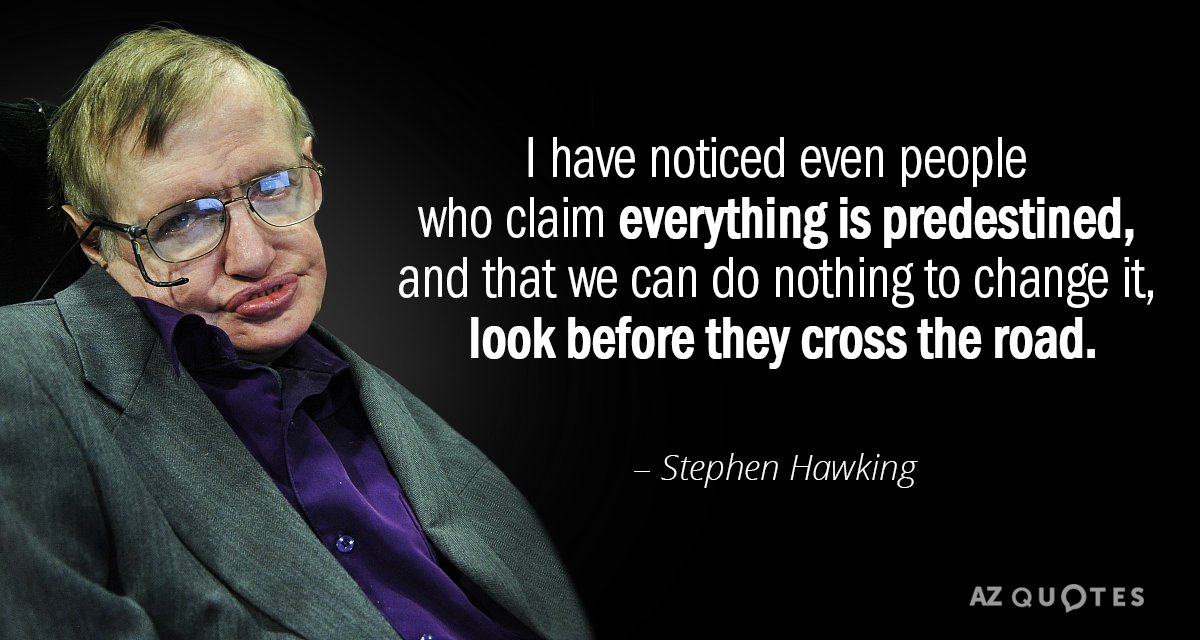
Stephen Hawking quote: I have noticed even people who claim everything is  predestined...

People need to realize that we need to make the conscious choice to chase a more successful future. Fate cannot lead people toward a better path. Individuals can only go towards better things by deciding to go there on their own volition. Results are a product of action people take towards those results, and choices are made by our own will and not by some intangible force that binds us to an unchanging and inescapable predetermined path. We are the masters of our own lives and we can use that to change ourselves for the better.